
Added value through structured, intelligently networked data
A PLM Open Hour from Intelliact AG
Mastering the connections between roles, processes, data and tools
The Internet of Things (IoT) plays a decisive role in the digital transformation of industry and services. Tailor-made IoT apps and platforms open up new opportunities to significantly increase efficiency, transparency, and customer satisfaction, particularly in after-sales and service.
Building an IoT platform is not a purely technical undertaking. Factors such as usability, performance, security, and the ability to integrate customer-specific processes determine its success. In globally active companies with heterogeneous requirements, IoT platforms must be scalable and flexibly adaptable – without compromising stability or security. The central question is: How can business value be created from complex data? Intelliact always considers two perspectives when it comes to IoT solutions:
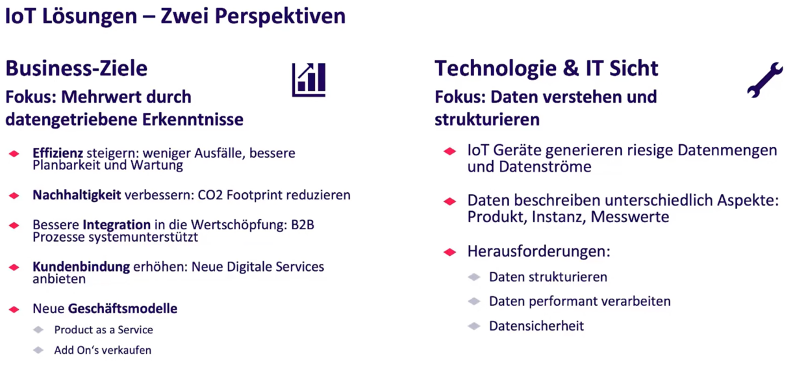
Customer journey as a starting point
In order to generate real added value from enormous amounts of complex IoT data, various aspects must be taken into account. An important insight from Intelliact: The success of an IoT project depends crucially on how well the solution is aligned with the customer journey. Only when data is mapped specifically to real customer use cases does real value emerge. This requires not only powerful technology, but above all a deep understanding of the processes, needs, and pain points of the users: Who uses the IoT platform and with what expectations? Who is allowed to see which data, and which data is needed in which view? The answers to these questions are relevant for UI and UX design as well as for the targeted preparation of data in the backend.
Practical example: Bucher Municipal – IoT perfection
Our customer Bucher Municipal provides a practical example of how all this can work in practice. The company is one of the world's leading suppliers of vehicles and equipment for cleaning and clearance work, with over 2,400 employees, 19 production sites, and customers on five continents.
Their IoT platform was visually outdated and no longer technically up to date. With the introduction of the IoT-based after-sales and service platform “Bucher Connect,” Intelliact – together with design partner Eyekon – helped the company revolutionize its fleet management. The completely redesigned and rebuilt solution enables customers to efficiently monitor their vehicle fleets – with real-time data, geographical overview, performance indicators, and customizable dashboards.
Three steps to a successful IoT solution
1. Define objectives
Define objectives and structure them in such a way that they can be implemented with the help of IoT data and generate added value.
2. Define the overall concept
Define the overall context between the master data (product structures, material master data, visualizations (3D), documents), the instance data (“as maintained” view, entities with serial numbers), and the IoT data (real-time streams, geographic data, performance parameters, status information).
3. Implement solution
Define functional modules, aggregate and transform data, design and implement the actual application
Structuring IoT data intelligently – for greater efficiency
A particular challenge in developing Bucher Connect was dealing with huge amounts of unstructured and sometimes inconsistent raw data. Intelliact therefore focused on three areas. Firstly, data generation and data transfer from the vehicle fleet. Secondly, on processing and preparing this data so that it can be used efficiently later on. And thirdly, on presenting it correctly and attractively to users on the IoT platform.
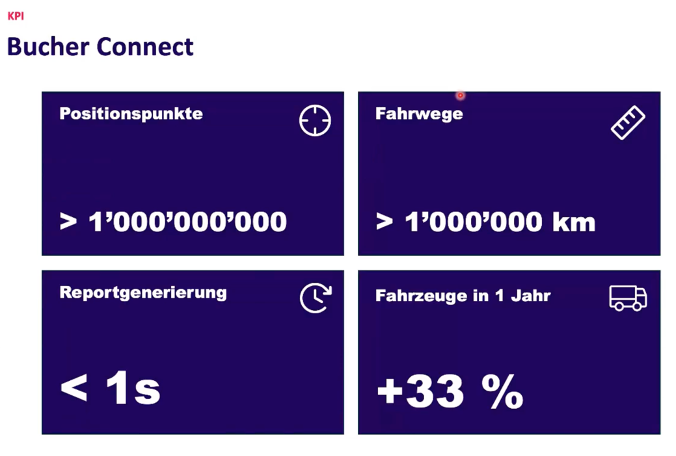
Today, Bucher Municipal's platform processes data from thousands of vehicles in less than five minutes – previously, this process took up to eight hours. The structured data is presented in personalized views according to the individual access rights of the users. The result: customers and rental companies can see the status, performance, and location of their vehicles at any time. Even short-term seasonal challenges – such as after major events or in the fall when leaves need to be cleared – can be handled more efficiently.
More power, better services
Thanks to structured IoT data, not only has performance been improved—the loading time for the vehicle overview has been accelerated 20-fold—but functionality has also been significantly expanded. Product data is now linked directly to the vehicles, which makes maintenance and repairs much easier. At the same time, the platform supports energy monitoring and helps companies achieve their sustainability goals.
Customer focus as a success factor
What sets Bucher Connect apart is its uncompromising focus on user-centricity. The platform is not only state-of-the-art in terms of technology, but also tailored to the daily requirements of customers and service organizations – intuitive to use, secure, fast, and highly relevant. In April 2025, Bucher Connect was awarded the title “Master of Swiss Web,” along with five other prizes—including three gold and three silver. The platform is continuously being developed, for example with the integration of additional analytics functions and a spare parts shop. There are also ideas in the areas of service planning and maintenance and warranty cases.
Conclusion: IoT apps and IoT platforms reach their full potential when there is a clear understanding of the product model, the organization is optimally mapped, and the applications are consistently developed in line with customer needs. The example of Bucher Connect impressively demonstrates how structured data, scalable technology, and a strong user focus can create a real competitive advantage – right through to after-sales and service.
PLM Open Hour
The opportunities offered by IoT apps for after-sales and service!
Generating added value from data is one of our main goals for our customers. But what do we do when we have enormous amounts of data at our disposal, as is common in the IoT world?
In this PLM Open Hour, we used the example of our customer Bucher Municipal's “After Sales and Service Platform” to present:
- Why the customer journey is the key to a successful IoT project
- How you can efficiently map data to the customer journey
- Which factors influence the complexity of an IoT platform
You learned how IoT enables customers to efficiently monitor products, find the necessary spare parts at the right time and in the right place, and order them as easily as possible.
Click here to view the presentation:
We recorded the webinar “The opportunities of IoT apps for after sales and service!” Register here to receive the access link:
PLM Open Hour
How Bucher Municipal creates business value from complex data
In this PLM Open Hour, we used the Bucher Connect project from Bucher Municipal AG to demonstrate how complex IoT applications can be successfully implemented—with significant benefits for customers, service organizations, and the company itself.
You learned how specific practical challenges were solved—and what is important when implementing powerful, secure, and user-oriented IoT solutions:
- Handling large amounts of unstructured, complex, and sometimes inconsistent raw data
- Implementing high requirements for usability, performance, and security of the application and app
- Integrating customer-specific processes and requirements into a scalable platform
Click here to view the presentation:
We recorded the webinar “IoT in practice – how Bucher Connect creates business value from complex data.” Register here to receive the access link: